
More and more customers ask ChatGPT or Gemini before they ever call you. But here’s what most businesses miss: AI engines don’t cite all content equally. Some content types they love to pull an answer from, and others they skip entirely.
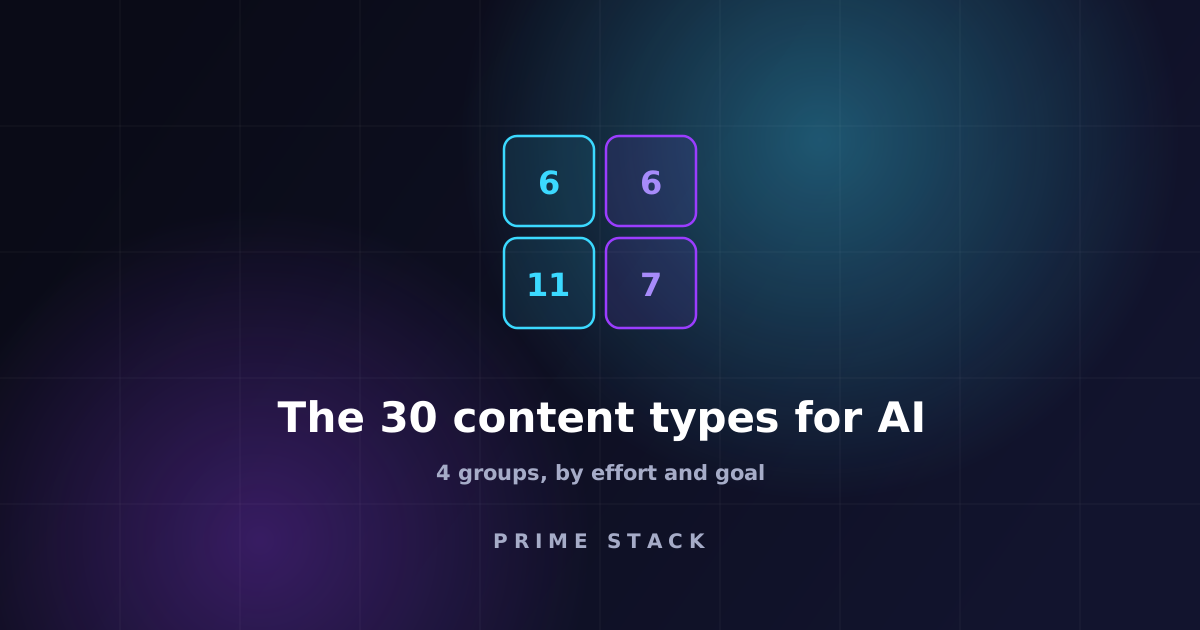
After building and analyzing dozens of sites, we mapped the 30 content types that keep showing up in AI answers. They split along two axes: how hard they are to create, and their goal: earning citations (the engine mentions you) or conversions (the visitor becomes a customer). This is the framework we work by.
The four groups
1. Easy to create, citation-focused. FAQ, glossary, direct answer, checklist, tips, a recommended-tools list. Little effort, high citation potential, because it’s exactly the format an AI engine can quote. Start here to build visibility fast.
2. Easy to create, conversion-focused. Product page, landing page, pricing page, testimonials, local service page, and a downloadable template. Most sites already have some of these, but usually written once and never touched since. Worth revisiting, because when AI starts sending people your way, these are what turn traffic into customers.
3. Harder, citation-focused. How-to guide, beginner guide, troubleshooting guide, field-tested principles, common mistakes, and at the heavier end: ultimate guide, pillar page, industry report, original research, statistics roundup, expert interview. These take real work but build deep authority. An AI engine cites a thorough guide or original research again and again, for years.
4. Harder, conversion-focused. Comparison, alternatives, a top-of-field list, use cases, case study, buyer’s guide, and an ROI calculator. These capture high-purchase-intent customers. Someone searching “the best tool for X” is close to buying, and this content converts at high rates.
The strategy: touch all four quadrants
The common mistake is writing in only one quadrant. Someone who writes only guides builds authority but never closes a deal; someone with only product pages converts but is never seen at all. A strategy that works looks like this:
- Start with the easy citation content (quadrant 1), to build fast visibility in AI engines.
- Sharpen the easy conversion content (quadrant 2), so the traffic already arriving turns into customers.
- Add the heavy authority content (quadrant 3), to compound over time.
- Close with the heavy conversion content (quadrant 4), for high-value deals.
How do you know where you stand?
That’s the most important question: which of the 30 types do you already have, and what’s missing? Most businesses discover they’re strong in one quadrant and completely empty in the other three.
Our digital health report does exactly this: it scans your site, maps the content against the 30 types, shows you what you have and what’s missing in each quadrant, and gives a prioritized plan of what to create first, based on what pays off most for your specific site. So instead of guessing, you know exactly where to start.