
TheBoss is a digital magazine for Israeli small business owners: 54 articles on money and taxes, running a business, bureaucracy, marketing and information security, across six categories. Until this week it ran on WordPress. Now it runs on Astro.
This is not a one-page brand site. It is exactly the kind of site people say “you can’t move that to code” about - lots of content, a growing archive, and posts scheduled to go live on future dates. So let’s look at what happened.
Drag and see for yourself
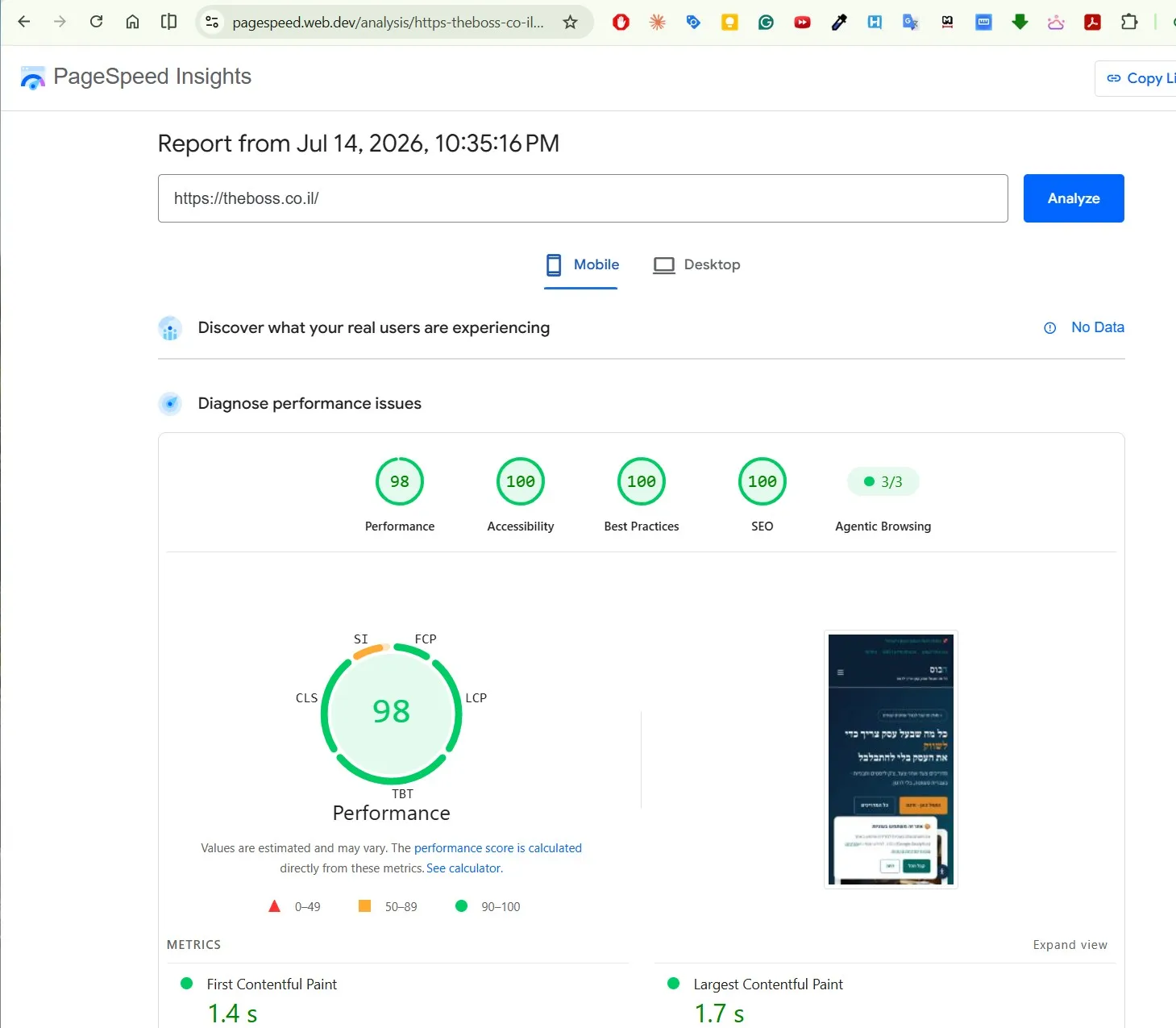
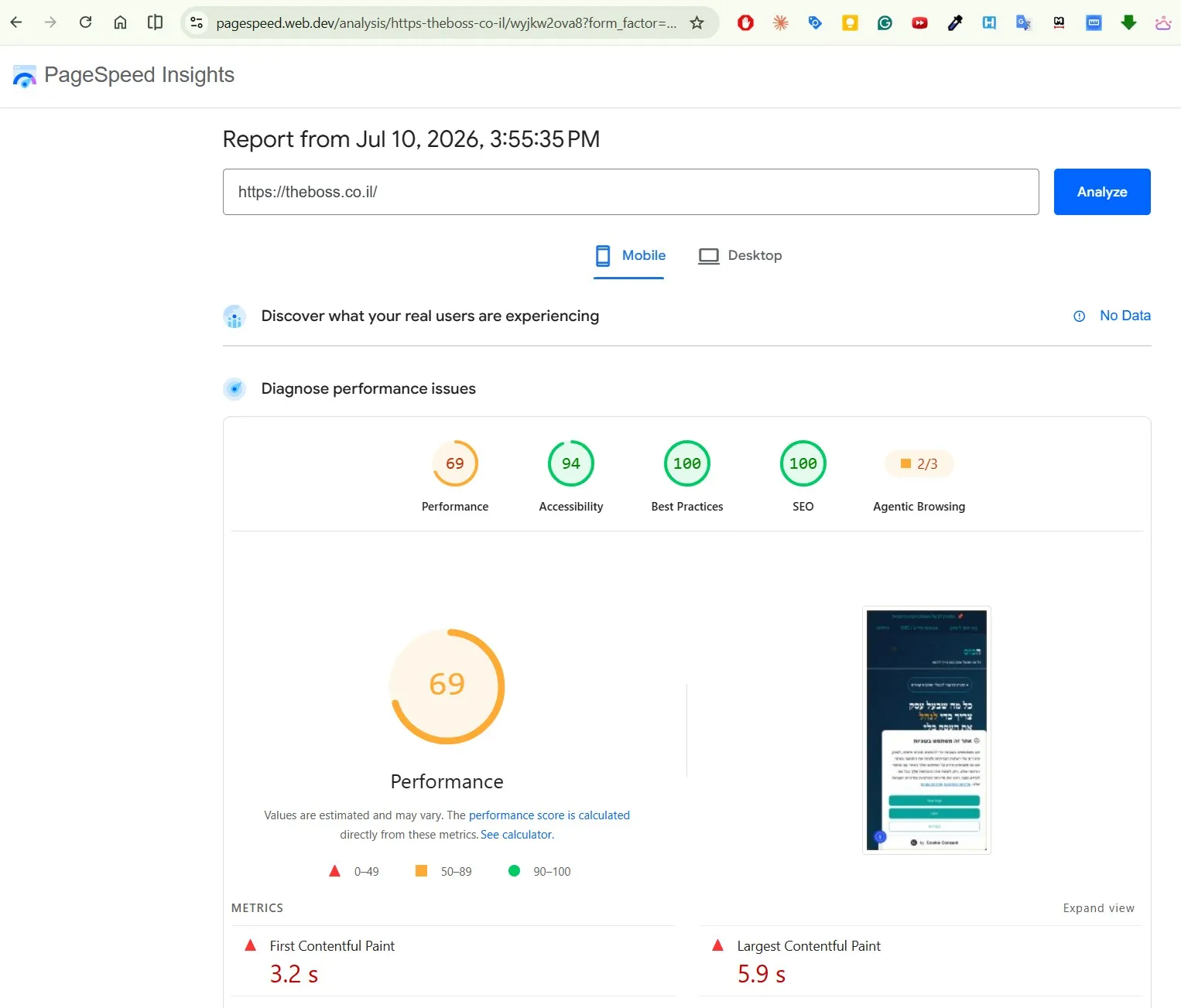
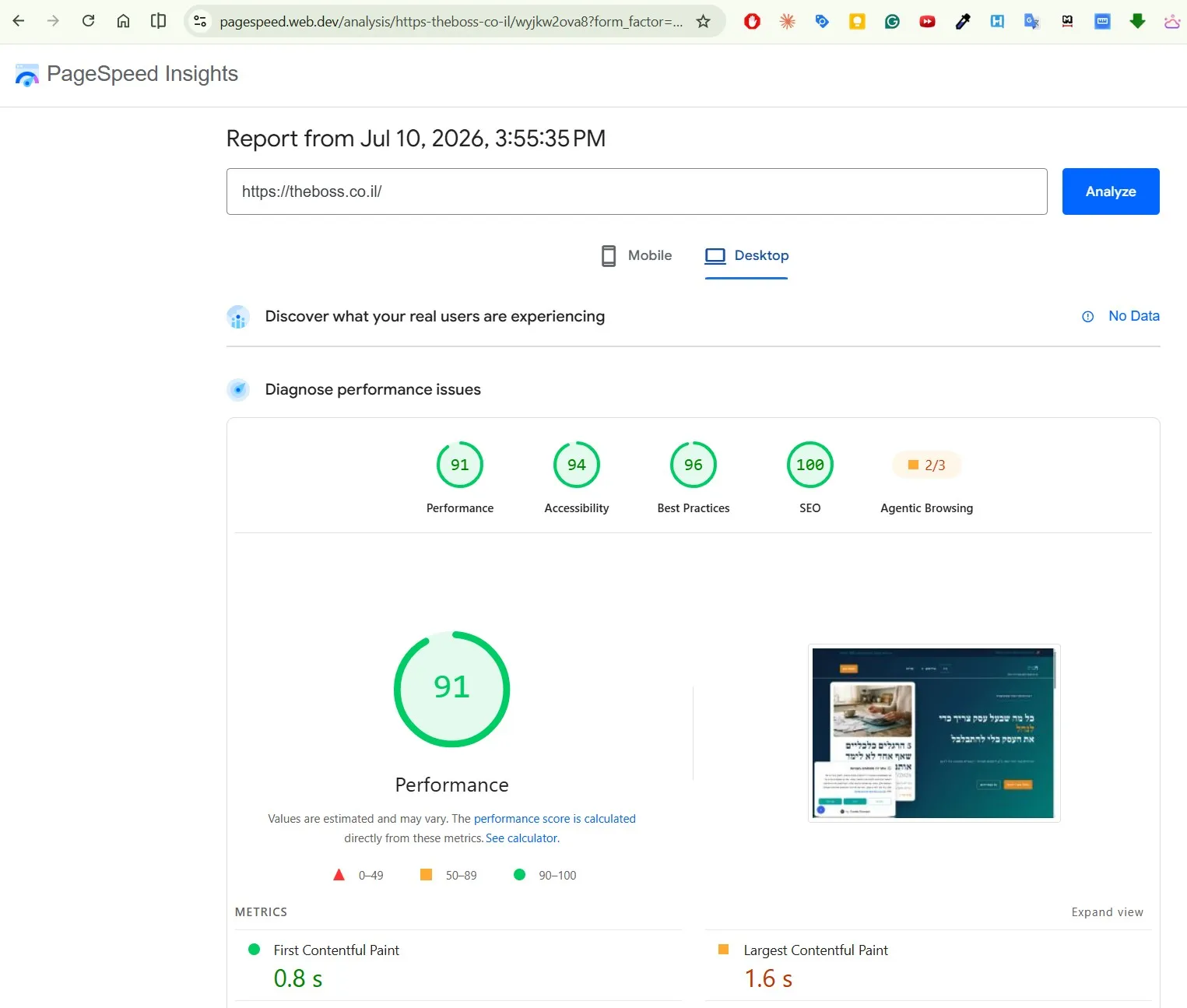
Both reports below are of the same homepage, in the same tool - Google PageSpeed Insights. On the right: the site on WordPress. On the left: the same site after the move to Astro. Drag the handle.
 BeforeAfter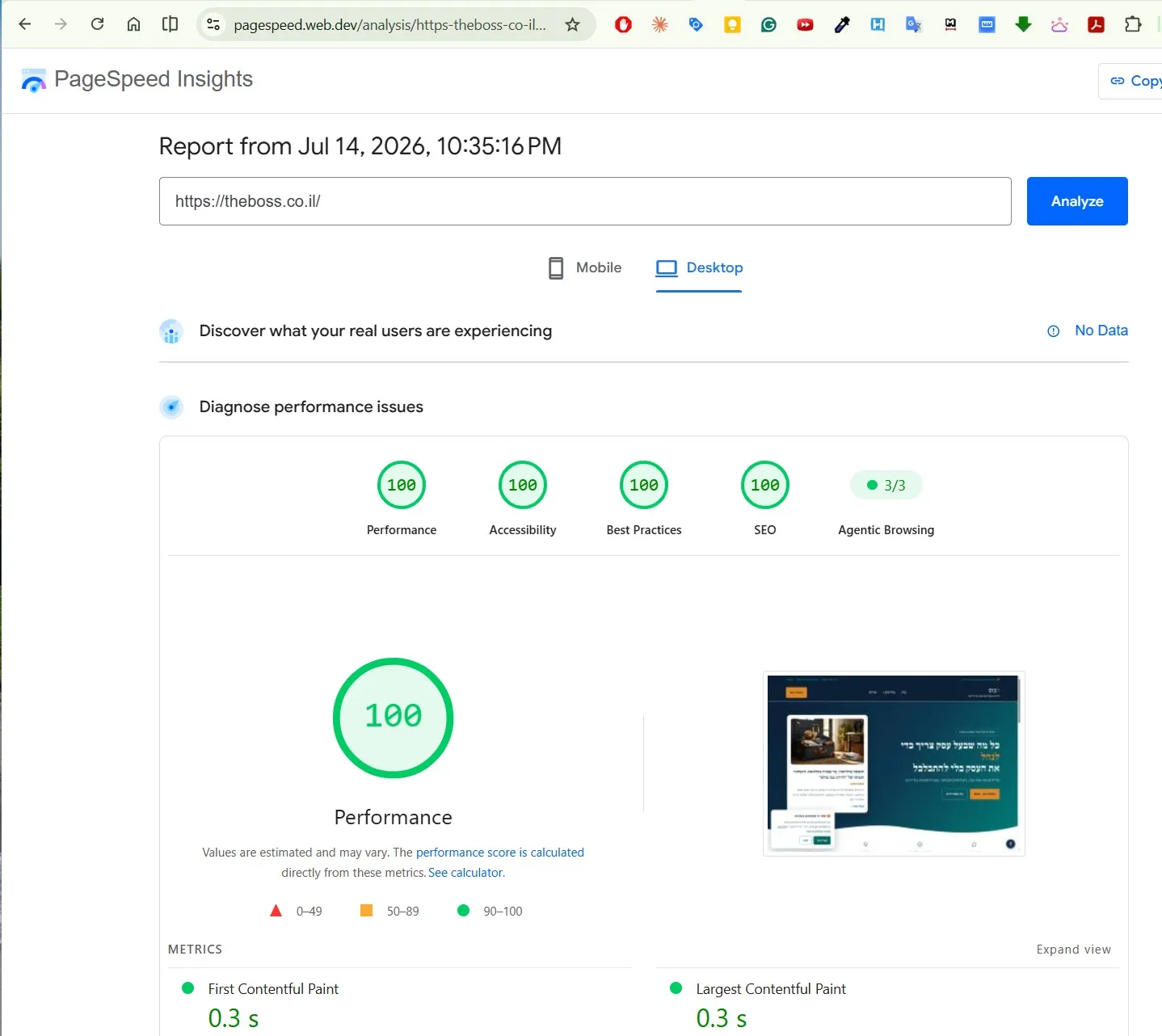
 BeforeAfter
Without the dragging:
| WordPress | Astro | |
|---|---|---|
| Performance (mobile) | 69 | 98 |
| Performance (desktop) | 91 | 100 |
| Accessibility | 94 | 100 |
| Best Practices (desktop) | 96 | 100 |
| Largest Contentful Paint, mobile | 5.9s | 1.7s |
5.9 seconds on mobile is not a technical number. It is a business owner who tapped a link in WhatsApp, stared at a white screen, and closed it.
The number nobody noticed
Look at both screenshots again, at the far end of the row of circles. There is something there that was not there a year ago: Agentic Browsing.
It is a new category Google started showing in the report, and it does not measure speed. It measures how well an AI agent can read your site and navigate it - ChatGPT trying to answer a customer’s question, Perplexity looking for a source to cite, or an agent trying to complete a task on the site on behalf of a user.
On WordPress, TheBoss scored 2 out of 3. On Astro, it scored 3 out of 3.
This is the moment the thing we have been writing about here for months stopped being a prediction and became an official metric inside a Google tool. If you have not read them yet, now is the time: How ChatGPT reads your website and GEO: how customers find you through ChatGPT.
The reason Astro scores a perfect three here is simple. A site built in code ships clean HTML with the content written inside it. A typical WordPress site ships layers of scripts that assemble the content on the fly. A human visitor waits. An AI agent simply doesn’t see part of the content, and moves on to the next site.
”But a static site can’t schedule publishing”
That is the first objection that comes up when you talk about moving a blog or a magazine to code, and it sounds reasonable: WordPress has a server running all the time, and you can tell it “publish this post Monday at 9:00.” A static site has no server. So how?
Of TheBoss’s 54 articles, nine have not been published yet - they are written, illustrated, and waiting for their assigned date (the last one: July 26). The system works like this:
- Every article carries a publish date.
- The site build simply skips articles whose date has not arrived - they never reach the live site, and nobody can reach them by URL either.
- A scheduled job runs the build again every morning.
- On the morning the date arrives, the article just appears. Without anyone touching a thing.
It is the same system that powers the blog you are reading right now. A static site does not mean a dead site - it means a site that is already prepared in advance.
And what about SEO? 54 URLs is no joke
This is where a migration like this fails for other people. When you move a magazine with dozens of articles, every URL that changes is an article Google already ranks that suddenly leads to an error. Here all 54 URLs stayed exactly as they were, along with the titles, the descriptions and the sitemap. As far as Google is concerned nothing moved - except that the site now loads three times faster.
The bot that sits on top of all that content
Every site we maintain comes with an AI rep - a bot that answers visitors based on the business’s own content and hands you a lead with a name and a phone number, without the visitor ever filling in a form. On a site with 54 articles that is worth double: everything you wrote becomes the knowledge base the bot answers from.
Want to see how it feels? Our own bot is sitting in the corner of this screen - just talk to it. It is the same bot that would sit on your site.
Now go test your own site
The test is free and takes a minute: search Google for google speed test, click the first result (PageSpeed Insights), paste your site’s address and hit Analyze. Don’t forget to look at the Agentic Browsing row too.
Got an orange score? Let’s talk about upgrading your site ↗
Want to understand how the migration works first? Everything is on the site upgrade page ←