
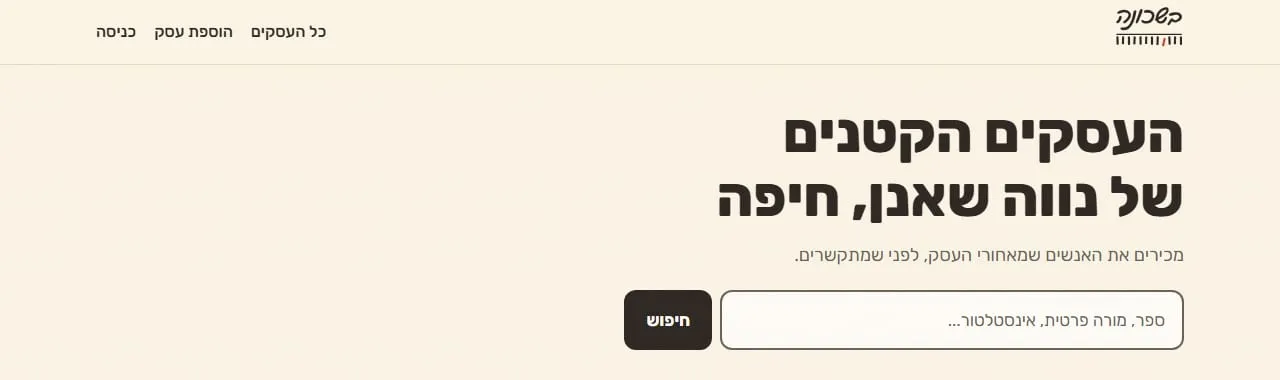
Bashchuna (Hebrew for “in the neighborhood”) is a directory of the small businesses of Haifa, neighborhood by neighborhood. It started in Neve Shaanan, the neighborhood where Prime Stack itself is based, and on November 10, 2026 it opened to all 54 neighborhoods of the city. The idea came up on October 28, 2026, and the site went live on November 9.
What this post is about: this is a portfolio post. Bashchuna is our own project, not a client’s, so we can show everything: what is on the site, how the decisions were made, and what was dropped along the way. It is not a case study with before and after measurements, because before this site there was no site at all.
What you will find here
- Why build a business directory at all, when there is Google
- What is on a business card, and why the owner is at the center
- The notice board for neighbors, added on November 11, 2026
- How the site avoids empty pages
- How the design was chosen, including the direction Eyal picked over our recommendation
- What you cannot see from the outside: security, accessibility and AI agent readiness
- What a local business can take from it
Who this post is for: small business owners in Haifa, and anyone considering a site with listings, user sign-up or content that other people add, who wants to see a real example before talking to anyone.
Why a directory, when there is Google
When you search for a barber, a private tutor or a plumber, Google returns names, stars and phone numbers. What it does not return is the person. Who is behind the business, how long they have been in the neighborhood, and what they say about themselves in the first person.
Bashchuna answers that in one line at the top of the site: “Get to know the people behind the business, before you call.”
There is another side too, and it is worth saying openly: Bashchuna is a way for Prime Stack to get to know business owners in the neighborhood. It is not a business in its own right, and a card in the directory costs the business owner nothing.
What we built
The site has three layers, like a real neighborhood:
- The home page, focused on Neve Shaanan, where it all started.
- A page for all of Haifa, with every business and all 54 neighborhoods, organized by the city’s nine official quarters.
- A page for every neighborhood, with its businesses, plus a section called “also serving…” for businesses from other neighborhoods that come to it.
And at the center of it all: the business card.
What is on a business card
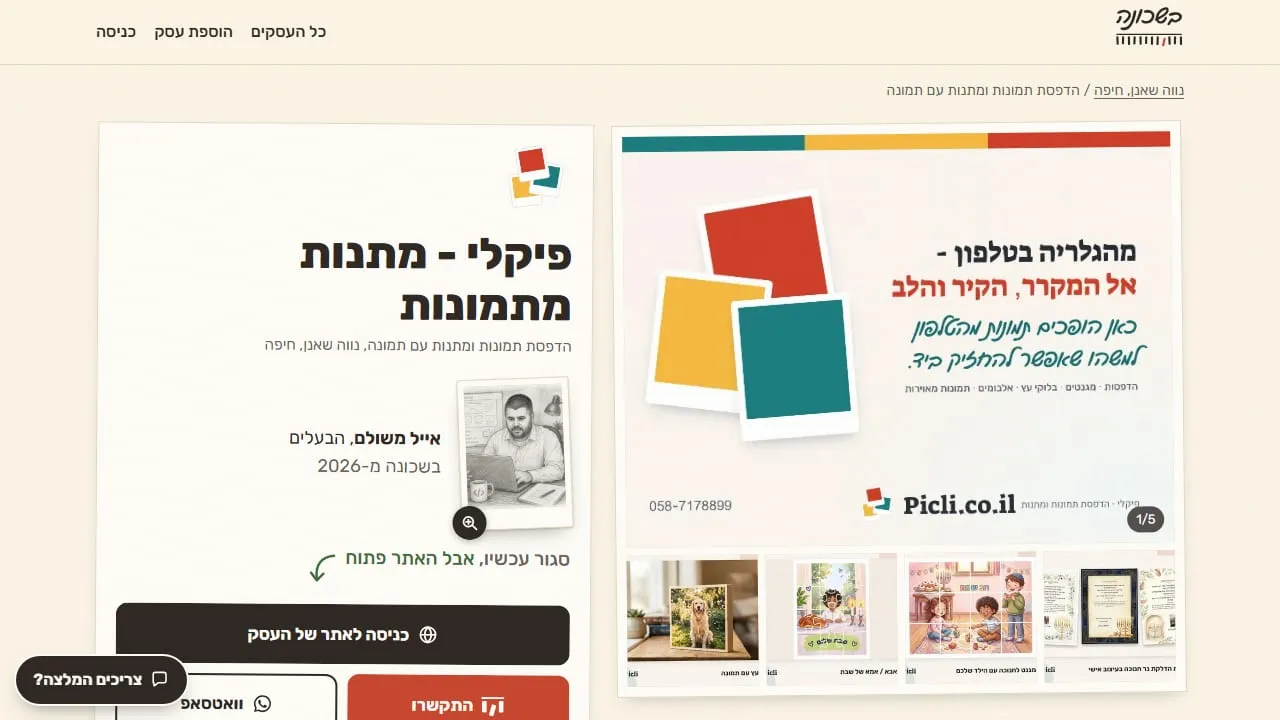
- The owner, front and center, with a paragraph they write in the first person. Not “a leading company in the field”, but what they do and why.
- A main image and four more. For each image you can choose which part of it is shown, or show it in full.
- “Open now”, calculated from the business hours. And when the business is closed but has a website, the card says so explicitly: “Closed now, but the website is open”, with a button to the site.
- Shabbat and kashrut, service areas and delivery. Details many people in Haifa ask about before they call.
- Recommendations from neighbors. Positive recommendations only, no stars, and every one is approved by a person before it is published.
How a business gets listed
A business owner signs up on their own, on a dedicated page for business owners. Login is with a Google account or a code sent by SMS, with no password to remember. Google login runs entirely on the server, with no Google code inside the page, and the site asks Google only for a name and an email address. And one person is one account: someone who connects both Google and a mobile number lands in the same account, and if two accounts were opened by mistake, they merge as soon as the two are connected. Every new card and every change is approved by hand before it goes live, and every time something is waiting, an email alert goes out. The owner sees the card before it is published and can take it down at any time.
An AI rep called “Need a recommendation?”
The site has an AI rep you can ask, for example, who in the neighborhood fixes computers. It knows every business by what is written on its card. More about reps like this on our AI rep page.
A notice board for neighbors
On November 11, 2026 the site gained a notice board for neighbors (in Hebrew). Businesses stay in the directory, and the board is for everything else: items for sale, rentals, services, lost and found, and community announcements.
- Only a logged-in user can post, and every notice is approved by a person before it goes live. The same rule that applies to business cards and recommendations.
- A notice does not stay forever. It is shown for 30 days from approval, or 60 days if the poster chooses that, and is then deleted together with its images. That way the board has no notices for an apartment that was rented long ago.
- A main image and up to four more. Images are shrunk in the browser before they are uploaded. In our test, a 4000 by 3000 pixel photo came down to 40KB.
- The poster decides how to be reached: a visible phone number, a WhatsApp button, or both.
How the site avoids empty pages
A site with 54 neighborhoods can easily become a site with 54 empty pages. Google does not like pages like that, and neither do people. So two rules were set:
- A neighborhood page stays out of Google until it has a business. The page exists and you can reach it, but it does not compete in search results until it has something in it.
- A category page inside a neighborhood opens only from 3 businesses. Until then, the businesses appear on the neighborhood page.
We wrote about this side of local SEO in our local SEO guide.
The design: a neighborhood notice board
We prepared several directions, and Eyal picked the third one, over a cleaner direction we had recommended. Here “notice board” is the name of a design, which was on the site from day one. The notice board for neighbors described above is a separate part, added after it.
- A notice board. Every business appears as a slightly tilted note, taped on, like a notice on the board at a building entrance. The colors come from a “neighborhood notebook”: dark brown ink on cream paper.
- Each color has one job. Red only for the “Call” button. Yellow only for the “New in the neighborhood” label. Green only for “Open now”. When a color always means the same thing, the eye learns it fast.
- A handwritten logo. The word “Bashchuna” in handwriting, with tear-off tabs below it, like a “for rent” notice. One of them has already been torn off, in red.
- Three effects only. A paper texture, a gentle reveal on scroll, and a tab that tears off when you press “Call”. Other effects were dropped on purpose, for example a custom mouse cursor, which hurts accessibility.
- No stock photos. The images on the site come from the businesses themselves: taken on a visit to the business, or uploaded by the owner. We explained why that matters in our post on photos for a business website.

What you cannot see from the outside
- Security. A site people sign up to and upload images to has to be locked down well. Every form is protected against submissions from a foreign site, SMS code login is limited in attempts and has a daily cap, and an uploaded image is re-encoded in the browser, which strips its hidden data, including the location where it was taken.
- Privacy. When a business is removed from the site, its image and logo files are deleted from storage too, with an explicit warning shown before the removal. User consents are recorded in the database: what was approved, when and how.
- Accessibility. An automated WCAG 2.2 AA scan of the site, at phone and desktop sizes, returned zero errors. We explained why an automated scan is only the start in our post on automated scores and compliance.
- Shabbat. The site closes automatically on Shabbat and holidays by Haifa times. Here is how that works behind the scenes.
- AI agent readiness. In Cloudflare’s scanner the site reaches the top tier, Level 5, and passes 14 of 15 checks. The last one is waiting for a setting at the domain registrar. What that means and why it matters.
- Structured data. Every card carries a structured local business description, so Google and AI engines understand what the business is, where it is and when it is open.
The numbers
On November 10, 2026 we ran Lighthouse on the live site. It is important to say: this is one run per page, not a median of several runs, so these numbers are a snapshot, not a final measurement. Why one test is not enough.
| Page | Mobile performance | Desktop performance | Accessibility, best practices, SEO |
|---|---|---|---|
| Home page | 99 | 100 | 100 |
| All of Haifa | 99 | 100 | 100 |
| Business card | 98 | 99 | 100 |
| Another business card | 100 | 100 | 100 |
Layout shift on every page: 0. The same day also had a before and after moment: in the first test, mobile performance stood at 88. After a round of fixes it rose to 98 to 100. And separately: since pages are cached at the network edge for 5 minutes, the server answers within 20 to 40 milliseconds, against 660 before.
What your business can take from this
Even if you are not building a directory, four things from this site apply to any local business:
- Show the person. A customer in the neighborhood wants to know who they are talking to. A first-person paragraph and a real photo of you do more than any marketing slogan.
- Do not open empty pages. A page with nothing to say yet is better off waiting. A few full pages beat many thin ones.
- One color for one action. If the most important button on your site is “Call”, give it a color that appears nowhere else.
- What people add, a person approves. Any site that takes content from outside, listings, comments or recommendations, needs someone to go over it before it goes live.
Summary
Bashchuna was built from scratch in 12 days: a directory of Haifa’s small businesses, with 54 neighborhoods, a business card with the owner at the center, self sign-up with manual approval, an AI rep, a notice board for neighbors, and login with Google or an SMS code. The design is a neighborhood notice board, with no stock photos, and mobile performance stands at 98 to 100 in the November 10, 2026 test.
Have a business in Haifa? Add it to Bashchuna (the site is in Hebrew). And want a site for your business? Tell us what your business does, and we will come back with a direction and a quote.